
By - PolyEyes Staff
views 6458
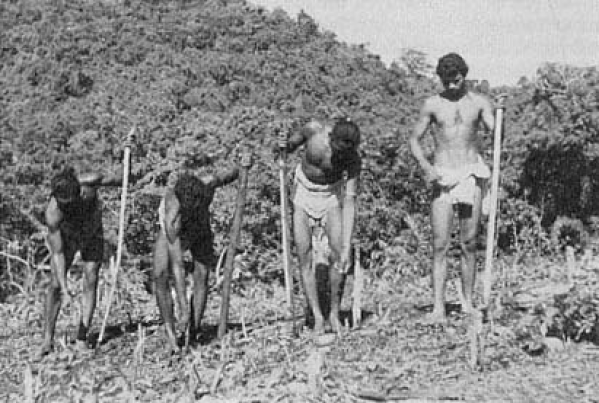
Birhors are the living cultural tribal heritage of Jharkhand, West Bengal and Orissa are struggling to avert their extinction despite of concentrated effort taken by government in last 50 years to give them a settled life out of their original nomadic practice to bring them in mainstream of civilization.
Etymologically the name Bihrhor derived from jungle people - Bir means jungle, Hos mean people. Birhors are the forest dweller people from a primitive race of tribal/Adivasi , by habit nomadic, living primarily in the Hilly state of Jharkhand. They have their own language known as Birhor language, which belongs to the Munda group of languages of the Austro-Asiatic language family.
They are found using the popular languages of the areas they move around and use Sadri, Santali, Ho, Mundari, Oriya and Hindi as well. By religion they follow Hinduism and traditional faith Pentecostal Christianity is making roads in their society.
Physiologically Birhors are of short stature, long head, wavy hair and broad nose. They are the member of the Proto-Australoid racial group. They claim they have descended from the Sun and believe that the Kharwars, who also trace their descent from the Sun, are their brothers. Ethnologically, they are akin to the Santhals, Mundas, and Hos.
Geographical Distribution of Birhor:
Birhors found mainly in the Jharkhand including the districts of Hazaribagh, Koderma, Giridih, Chatra, Ramgadh, Bokaro, Ranchi and Singhbhum. Now they are breaking up into several smaller units, in Jharkhand. Some of them are also found in Orissa, Chhattisgarh, West Bengal and Bangladesh as well. They are one of the smallest of the thirty scheduled tribes inhabiting Jharkhand.
Population: Birhor numbers around 9,000 as per some estimates and about half of them have their home in Jharkhand. According to the official latest count total number of Birhor in Jharkhand is 4377 which is reducing day by day and they are on the verge of extinction.
Socio-economic life style of Birhors:
The Birhor people practices “primitive subsistence economy” which is based upon the nomadic gathering and hunting. They love to trap Monkey, Rabbits and Titirs a small bird found in forest, they are expert in collecting honey and sell them to the people who reside around the forest. They have some indigenous skills to make ropes from the fibers of a particular species of vine, which they sell in the daily or weekly markets for some money.
It was also observed that some Birhors were seen to have settled into stable agriculture land, due to deforestation or encouragement by government, but most of them continue in their nomadic life, but even when they settle down in a village by the government programs, they are inclined to lead a nomadic life. As per their socio-economic standing they are classified into two groups. While the wandering or nomadic Birhors are called Uthlus, the settled or stationary Birhors are called Janghis.
It was observed in the Khambhawa village under Tatijharia Block of Hazaribagh District of Jharkhand where an Indira Awas colony (The home provided by government to give them a settled life) was made on the fringe of forest and offered several incentives but most of them recede back to the forest after few months. This is not a case of one place but it is the nature of the Birhors in this area.
We have visited with the help of an NGO named Social and Education Welfare Association (SEWA) that runs a campaign named “Save our Tribes” in and around Hazaribagh district. We accompanied SEWA in their various Blanket and woolen cloth distribution camp at various tandas located in Khambhwa, Katkamsandi, Demotand and Ichak.
We have observed that they sales their blanket given by the government and NGO’s for few buck (Rs 200 Blanket in Rs 40 or 50 only) to buy alcohol and recedes back to forest. We have seen that the localities exploits them as they offers food and few rupee for their entire day work one way the labor charge is about Rs 100 but these peoples are given Rs 25 only.
In another Birhor tandas located at Sijua and Sirsi which is around 20 Km away from the district headquarter .We have observed that apart of honey extraction, rope making the Birhor seen selling herbs as well surprisingly we have spotted Faguni a Birhor women selling medicinal herbs in Court campus of Hazaribagh.
Religion and Rituals:
Birhor peoples having spiritual Magico-Religious following. Mundari deities such as Sing Bonga the Sun God and Hapram which is their ancestral spirits rank top in esteem. Though the Hapram are expected to live in the supernatural world along with the Bonga, the Birhors make a distinction between these two categories of supernatural spirits. Hapram are placed just below the Bonga. The Birhor people believe that the entire universe has been constructed and presided over by Sing Bonga the Sun God and his wife Chandu Bonga. They are worshipped in the months of Pous and Magh as per Hindu calendar. As a result of contact with Hindu neighbors some Hindu deities such as Debimai, Kalimai, and Mahadev have found a place in their pantheon.
Settlement of Birhor:
Birhors lives in the temporary structure which is known as “Tandas or bands”. These consist of at least six huts of conical shape, erected with the support branches and covered by broad leafs. They are having traditional earthen utensils, digging implements, implements for hunting and trapping, rope making tools, baskets and so on. Now a days, plastic, fiber, aluminum and steel have also seen using by Birhor people.
Family and Marriage:
Smallest unit of Birhor society is their family which is traditionally follows the paternal patern. The husband-wife relationship in Birhor family is quite cordial. Their dressing patterns are influenced from there settled neighbors, are primarily in line with the traditional Indian dress with some light of western influence. Women are fond of traditional and spiritual ornaments. They are divided into several totemic clans named after birds, plants, animals, rivers, etc.
Birhor people strictly follows the rules of tribal and clan endogamy. A Birhor boy is always expected to get married with a Birhor girl only, but the clan of the boy and the girl must be different.
Despite the fact that tandas have families of different clans but they always follows the rule of tanda exogamy. At the time of marriage, the blood relationship is always explored by the families. The marriage between a boy and a girl is only possible when both are not related up to three generations from the father’s and the mother’s side.
Birhors follow the practice of bride price theory once their child attains the marriageable age; it is responsibility of their father to get his son or daughter married. As per traditional custom the father of the male approaches the father of the female for marriage. When the latter agrees, the father of the boy quotes and agrees over the bride price with father of the girl and then marriage gets fixed.
Attempted integration by Government:
After the independence of India government has taken serious initiatives to settle the Birhors by giving them free land, bullocks for cultivation, agricultural implements and seeds. Schools for their children, rope making centers and honey collection training facilities. Despite of all the incentive most of the Birhors have reverted back to their free nomadic life.
The Birhor are honest, peaceful people who seldom fight among themselves, avoid conflicts with villagers, and are “never involved in any crimes,” according to Bhattacharyya (1953).
Cause of their depleting population:
Birhors are basically dependent on forest resources, rapid deforestation causing problem for them. They refuse to take modern medical facility are dependent on herbs for treatment of disease. The mother mortality and child mortality rate is quite high although proper statistics are not available for this but it was visible during our visit that most of the people we have seen in their colony were old. They are addicted to homemade alcohol that they prepare by fermentation of rice.
Unhygienic life style causes health related issues added by the increasing pollution and interference of local people in their life style also turning out like a threat to them.
Reference:
Sunil Kumar Singh: Jharkhand 2003
Prasad: District Census Hand Book, Hazaribagh Patna
Annual report Social and Educational Welfare Organization 2011
Author: Dr. Nirmal Kumar Sinha and Pankaj Kumar
Related Articles
-
Bharat Celebrates 150 Years of Vande Mataram — The Anthem That Awakened a Nation
Vande Mataram 150 years, Bankim Chandra Chatterjee biography, Indian freedom songs, national song of India history, Vande Mataram celebration 2025, Indian unity in diversity, patriotic events India 2025, Indian cultural heritage, Bharat Mata 3D art, proud to be Indian, Vande Mataram 150 years, Bhara...
 created by PolyEyes Staff | publish 11 hrs ago | last updated 11 hrs ago 797 views | 1 recommendations | 0 comments
 -
Gen Z: The Most Powerful Generation Shaping the Future of Work, Money, and Culture
Discover Gen Z lifestyle, trends, work culture & digital habits. Explore how Generation Z is shaping the future of technology, marketing & society....
created by PolyEyes Staff | publish 11 hrs ago | last updated 11 hrs ago 2104 views | 1 recommendations | 0 comments -
🇮🇳 Maratha Military Landscapes Declared UNESCO World Heritage Site: India’s Fortified Legacy Goes Global
The Maratha Military Landscapes, featuring 12 iconic forts across Maharashtra and Tamil Nadu, have been declared a UNESCO World Heritage Site in 2025. Explore the history, significance, and travel details of these legendary Indian forts....
created by PolyEyes Staff | publish 11 hrs ago | last updated 11 hrs ago 767 views | 1 recommendations | 0 comments -
Central Sanskrit University: The Grand Comeback of India’s Lost Cultural Treasure
Central Sanskrit University is leading a cultural renaissance by merging Sanskrit, ancient Indian knowledge systems, and modern technology. This is India’s intellectual comeback....
created by PolyEyes Staff | publish 11 hrs ago | last updated 11 hrs ago 673 views | 1 recommendations | 0 comments -
🪆 Kanyaputri Dolls of Champaran, Bihar: India’s Intangible Cultural Asset with Global Heritage Value
Kanyaputri Dolls from Champaran, Bihar, are rare, handcrafted symbols of sibling love. Beyond tradition, they represent eco-conscious living, intangible cultural heritage, and a powerful model for rural women entrepreneurship and sustainable heritage investment in 2025....
created by PolyEyes Staff | publish 11 hrs ago | last updated 11 hrs ago 672 views | 1 recommendations | 0 comments -
🛕 Rajasthan’s Bahaj Village Unearths Ancient Remains from Mahabharata and Mauryan Periods
The ASI has discovered ancient urban remains from the Mahabharata and Mauryan periods in Bahaj village near Mathura. A historic moment for archaeology and Indian heritage....
created by PolyEyes Staff | publish 11 hrs ago | last updated 11 hrs ago 1023 views | 1 recommendations | 0 comments -
Vaishali Unveils Majestic Stupa-Inspired Buddha Samyak Darshan Museum – A New Global Buddhist Tourism Marvel
Explore the architectural marvel of the Buddha Samyak Darshan Sangrahalay in Vaishali, Bihar—built at a cost of ₹550.48 crore, sprawling over 72.94 acres, and adorned with 38,500 unique pink stones. A massive tourism magnet now open to the world....
created by PolyEyes Staff | publish 11 hrs ago | last updated 11 hrs ago 1037 views | 1 recommendations | 0 comments -
🧵 Kheta Embroidery Revival: Govt's ₹Crore Push to Empower Bihar's Artisans | NHDP, CHCDS, Bharat Tex 2025
Discover how the Government of India is transforming rural women artisans into global entrepreneurs through Kheta Embroidery of Bihar. Backed by NHDP, CHCDS, and Bharat Tex 2025—this initiative unlocks high-income, export-ready, and sustainable employment....
created by PolyEyes Staff | publish 11 hrs ago | last updated 11 hrs ago 1036 views | 1 recommendations | 0 comments -
World’s Tallest Freedom Icon! Dr. Rajendra Prasad’s 243-Meter Statue to Rise on Patna Marine Drive
Bihar is set to build the world’s tallest freedom fighter statue—243 meters high—honoring Dr. Rajendra Prasad on Patna Marine Drive. Know project details, cost, design, and political impact....
created by PolyEyes Staff | publish 11 hrs ago | last updated 11 hrs ago 1593 views | 1 recommendations | 0 comments -
Patna Kalam Painting: A Unique Indian Art Form That Captures Everyday Life
Discover the rich legacy of Patna Kalam, a unique Indian painting style from Bihar that blends Mughal, European, and Indian influences. Explore its history, features, famous artists, and revival efforts in this detailed guide....
created by PolyEyes Staff | publish 11 hrs ago | last updated 11 hrs ago 2293 views | 1 recommendations | 0 comments




-
🚀 Unemployment in India: Crisis, Causes & the Road to Jobs
April ,16 2026 - PolyEyes Staff -
🦋 Kya Aapko Pata Hai? Titli Ko Udne Ke Liye Do Baar Janm Lena Padta Hai
April ,13 2026 - PolyEyes Staff -
🌊 BIOROCK, Coral Reefs & Rann of Kutch: The Future of Ocean Restoration & Climate Survival
April ,12 2026 - PolyEyes Staff -
🌍 Oil War 2026: USA, Iran, Israel, Venezuela aur Petroleum ka Global Game (Aapki Pocket Ka Silent Killer 😅)
April ,06 2026 - PolyEyes Staff -
🛕🔥 Devari Mandir, Dhoni & CSK: IPL 2026 ka Divine Connection
April ,06 2026 - PolyEyes Staff -
Jharkhand Economy: Complete Notes for JPSC 2026 (Growth, Sectors, Challenges & Opportunities)
April ,05 2026 - PolyEyes Staff -
🤖 Best AI SEO Tools for Bloggers in 2026 (Rank Faster & Grow Traffic)
April ,05 2026 - PolyEyes Staff -
Jharkhand Industrial Policy (2001–2021): Complete Evolution, Analysis & JPSC PT Master Guide (2026)
April ,04 2026 - PolyEyes Staff -
🎓 Best AI Tools for Students in 2026 (Study Smarter, Not Harder)
April ,04 2026 - PolyEyes Staff -
Din-Raat Carbon Sokhne Wala Paudha: South African Spekboom Plant Jo Climate Change Se Lad Sakta Hai
March ,15 2026 - PolyEyes Staff -
Patkar Painting of Jharkhand: Complete Guide for JPSC Exam 2026 (History, Features, Facts & PYQ Focus)
February ,22 2026 - PolyEyes Staff -
PM JANMAN Yojana 2026: India’s Most Powerful Tribal Development Mission Explained
February ,20 2026 - PolyEyes Staff -
🚀 Top AI Tools to Make Money Online in 2026 (India Edition – Real Income Blueprint)
February ,18 2026 - PolyEyes Staff -
Best Health Insurance for Self-Employed USA 2026 – Affordable Plans, Costs & Expert Guide
February ,17 2026 - PolyEyes Staff -
Best Health Insurance for Small Business Owners USA 2026 – Complete Cost & Plan Guide
February ,17 2026 - PolyEyes Staff

Sir I've lost my admit card and I also forget my roll no
Please help me in other ways

Dear Sir,
After login when i click on attempt button to take test a error msg show "Test series ended", plesae resolve this issue.
sir, my name is SWARUP ANAND, my DOB- 01/03/1984, my father’s name- SANTOSH KUMAR SRIVASTWA. I have loss my admit card. Please tell my roll number.
BPSC mains 56th-59th me Roll No. 119040 pass hai aur PT me fail. Mahabhrstachar hai. pls see it must
I am thankful for PolyEyes for most authentic Online BPSC Test Series. These Test are life support for working Aspirant.
sir please tell the authenticity of this news .there is no such news on bpsc website and i heard 17 june as the exam date .please clarify the doubt
r u providing test for BPSC in HINDI medium ?
plz intimate me through emails about BPSC test packages and details of packages and its rate. how many test and when it will be taken plz send details about ur package plans.
Yes Test is available in Hindi as well English and Total Number of Test and Registration details already given above
Best thing im loving about This Test series is its Explanation part. Crisp and to the Point. Thanku Polyeyes.
-
 All Stories
 -
Recently Published Stories
-
Most Viewed Stories
-
Just In Photos
-
Most Viewed Photos
