
By - PolyEyes Staff
views 607
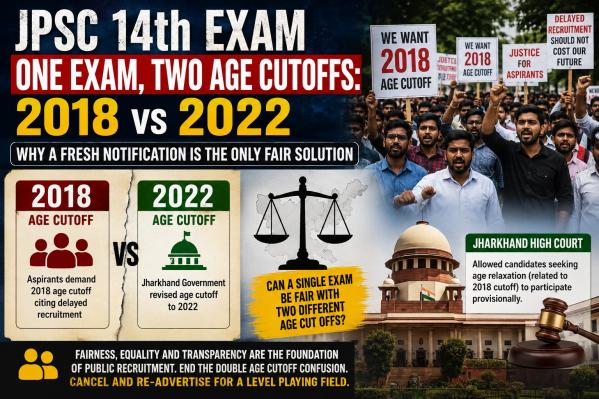
From a Recruitment Drive to a Constitutional Debate
The 14th Jharkhand Public Service Commission (JPSC) Civil Services Examination was expected to be a celebration for thousands of government job aspirants across Jharkhand. After years of delays and uncertainty, candidates finally saw an opportunity to compete for some of the state's most prestigious administrative posts.
However, what should have been a straightforward recruitment process has now transformed into one of the most controversial examinations in Jharkhand's recent history.
At the center of the controversy lies a simple but explosive question:
How can a single examination operate under multiple age eligibility standards at the same time?
Today, the debate surrounding JPSC is no longer limited to age relaxation. It has evolved into a larger discussion about fairness, equality, administrative accountability, and the credibility of public recruitment systems.
The Origin of the Controversy
For many years, Jharkhand government recruitment examinations have suffered from delays. Aspirants who were eligible several years ago gradually crossed the upper age limit while waiting for vacancies to be announced.
When the notification for the JPSC 14th Combined Civil Services Examination was released, age eligibility calculations effectively favored a later reference year, which many candidates believed was unfair because the delay was caused by the system rather than by the aspirants themselves.
Student organizations, civil service aspirants, and various social groups argued that candidates should not be punished for administrative delays. The protests gained momentum, and eventually the Jharkhand Government revised the age eligibility reference year to 2022.
While this decision brought relief to many aspirants, it also opened a new set of questions.
The 2022 Cutoff Solved One Problem but Created Another
Supporters of the revised 2022 cutoff argued that it restored fairness to candidates who had lost opportunities because examinations were not conducted on time.
However, critics pointed out that changing a fundamental eligibility criterion after the recruitment process had already begun created legal and administrative complications. In competitive examinations, eligibility conditions are supposed to be fixed and uniformly applicable to all candidates.
Once those conditions are altered, questions naturally arise:
-
Was the original notification defective?
-
If the original notification was flawed, should it continue?
-
Can eligibility rules be changed midway without affecting the integrity of the examination?
These questions remain unanswered.
The Forgotten 2018 Aspirants
The controversy becomes even more complicated when the demand for a 2018 age cutoff enters the picture.
Many aspirants argue that even the revised 2022 cutoff does not fully compensate candidates who lost opportunities due to years of delayed recruitment. According to these candidates, if vacancies effectively belong to an earlier recruitment cycle, then age eligibility should be calculated with reference to 2018 rather than 2022.
This argument reached the Jharkhand High Court.
In a significant development, the High Court granted interim relief to certain aspirants and allowed them to submit applications and participate in the recruitment process provisionally while their petitions remain under consideration.
This judicial intervention has created a unique situation.
Three Age Frameworks in One Examination
The JPSC 14th examination now finds itself caught between three different age-cutoff perspectives:
The Original Framework
The eligibility structure under the original notification effectively reflected a much later reference period.
The Revised 2022 Framework
The state government later revised the age calculation year to 2022, expanding eligibility for many candidates.
The 2018 Framework Under Judicial Consideration
Candidates seeking age relaxation linked to a 2018 reference year have received interim relief from the High Court and are participating provisionally.
As a result, one examination is now operating under three competing age-cutoff theories.
This is unprecedented and raises serious concerns regarding procedural consistency.
Can Equality Exist Under Multiple Eligibility Standards?
The Constitution guarantees equality of opportunity in public employment.
The principle is simple:
Every candidate should compete under the same rules.
When different groups of candidates enter the same examination through different eligibility pathways, questions about equal treatment become inevitable.
The issue is not whether one group deserves relaxation and another does not.
The issue is whether a recruitment examination can maintain public confidence when eligibility standards themselves are under dispute.
If one candidate is eligible because of the 2022 revision and another is participating under court protection based on claims related to 2018, then the recruitment process itself becomes vulnerable to future challenges.
Administrative Delays Should Not Destroy Careers
At the heart of this controversy lies a deeper problem. Most candidates are not demanding special treatment. They are demanding fairness.
Thousands of young people spent years preparing for civil services examinations while recruitment cycles remained irregular. Some crossed the age limit during this period.
Others postponed career decisions because they expected vacancies to be announced sooner. When government institutions delay recruitment, candidates bear the consequences.
This is precisely why the age-cutoff issue has generated such strong emotions among aspirants. For many candidates, it is not merely a technical legal dispute. It is a question of lost years, missed opportunities, and uncertain futures.
Why a Fresh Notification May Be the Cleanest Solution
Supporters of cancellation argue that continuing the examination under multiple age frameworks could create even greater problems later. A fresh notification would offer several advantages:
One Uniform Eligibility Standard
Every candidate would compete under the same age criteria.
Reduced Litigation
Many ongoing disputes could become irrelevant if a fresh notification resolves eligibility concerns comprehensively.
Greater Transparency
A re-advertised examination would remove doubts about procedural fairness.
Stronger Public Trust
Candidates would have confidence that the recruitment process is based on a single, universally applicable set of rules.
Public service examinations depend on credibility. Once credibility is questioned, even the final results may face challenges.
The Risk of Future Legal Complications
The biggest concern for aspirants is uncertainty.
If courts later decide that a different age-cutoff year should have been applied, the consequences could affect the entire recruitment process.
Candidates who spend months preparing for prelims, mains, and interviews deserve certainty.
No aspirant wants to clear multiple stages of an examination only to discover that the process itself has become entangled in prolonged litigation.
This uncertainty benefits nobody—not candidates, not JPSC, and not the state government.
Merit Should Win, Not Technical Controversies
The purpose of a civil services examination is to identify the best administrative talent available.
Ideally, discussions should focus on governance, public policy, leadership, and merit.
Instead, the conversation has become dominated by procedural disputes and age-cutoff calculations.
This is unfortunate.
Jharkhand needs capable future administrators.
Those future administrators deserve a recruitment process that is transparent, legally sustainable, and universally accepted.
Final Verdict
The JPSC 14th Civil Services Examination has evolved into far more than a recruitment exercise. It now represents a test of fairness, transparency, and institutional credibility.
With candidates linked to the original eligibility framework, the revised 2022 cutoff, and court-protected claims associated with the 2018 cutoff, the examination finds itself navigating an unprecedented triple age-cutoff controversy. Whether the courts ultimately uphold one framework or another remains to be seen.
However, from the perspective of administrative clarity and equal opportunity, many aspirants believe that cancelling the current notification and issuing a fresh advertisement with a single uniform age cutoff may be the most transparent and legally sustainable path forward.
A recruitment process should unite aspirants in competition—not divide them through conflicting eligibility standards.
FAQs
Why is the JPSC 14th Exam controversial?
The controversy revolves around changing age eligibility criteria and the existence of competing demands for 2018 and 2022 age-cutoff years.
What is the 2022 age-cutoff issue?
The Jharkhand Government revised the age calculation reference year to 2022 after protests from aspirants affected by recruitment delays.
Why are some candidates demanding a 2018 cutoff?
They argue that vacancies relate to earlier recruitment cycles and therefore age eligibility should be calculated from an earlier reference year.
Why do some aspirants want the examination cancelled?
They believe a fresh notification with one uniform eligibility standard would ensure fairness and reduce future litigation.
Related Articles
-
JPSC PT Result Without Cut-Off, Final Answer Key Disputes & Just 16 Days for Mains: Why Aspirants Are Calling the 14th Recruitment Process Unfair
The JPSC 14th Civil Services recruitment has sparked controversy after the PT result was declared without publishing category-wise cut-off marks, disputed answers allegedly remained in the final answer key, and candidates received only 16 days for Mains preparation. Read the complete analysis....
 created by PolyEyes Staff | publish 11 hrs ago | last updated 11 hrs ago 301 views | 1 recommendations | 0 comments
 -
JPSC 14th Prelims Result Sparks Massive Controversy: No Cut-Off, No Member Signatures, Multiple Correct Answers – Is a Fresh Recruitment the Only Fair Solution?
JPSC 14th Civil Services Preliminary Result has triggered fresh controversy over missing cut-off marks, unsigned result, multiple correct answers, and only 16 days for Mains. Experts demand cancellation and clubbing with JPSC 15th recruitment with age relaxation....
created by PolyEyes Staff | publish 11 hrs ago | last updated 11 hrs ago 588 views | 1 recommendations | 0 comments -
Jharkhand Economy: Complete Notes for JPSC 2026 (Growth, Sectors, Challenges & Opportunities)
Complete Jharkhand economy notes for JPSC with sectors, minerals, and key insights for quick revision....
created by PolyEyes Staff | publish 11 hrs ago | last updated 11 hrs ago 531 views | 1 recommendations | 0 comments -
🔥 Disaster Management in Jharkhand (JPSC) – Complete Notes | Polyeyes
Complete JPSC notes on Disaster Management in Jharkhand with lightning, drought, floods, mining disasters, institutions, diagrams & FAQs. Exam-ready guide for PT & Mains 2026....
created by PolyEyes Staff | publish 11 hrs ago | last updated 11 hrs ago 1242 views | 1 recommendations | 0 comments -
ISFR Jharkhand Forest Report 2025 – Complete Guide with Data, MCQs & Mains Questions (JPSC Special)
Latest ISFR Jharkhand Forest Report with verified data, forest cover analysis, important MCQs and Mains questions for JPSC Prelims and Mains exam....
created by PolyEyes Staff | publish 11 hrs ago | last updated 11 hrs ago 1162 views | 1 recommendations | 0 comments -
Bihar SSC Recruitment: 25% Extra Marks for Contractual Employees – Is It Gross Injustice to Freshers
Bihar SSC Recruitment sparks controversy as contractual employees get 20% extra marks. Freshers label it gross injustice. Full analysis, reactions & expert views here....
created by PolyEyes Staff | publish 11 hrs ago | last updated 11 hrs ago 1599 views | 1 recommendations | 0 comments -
BPSC 71st Answer Key 2025 (Out): Download Official PDF, Objection Window, Cutoff Trends
BPSC 71st Answer Key 2025 is out! Download the official PDF, check your answers, raise objections online, and know the expected cutoff for General, OBC, SC/ST categories. Stay updated with BPSC Prelims 2025 latest news...
created by PolyEyes Staff | publish 11 hrs ago | last updated 11 hrs ago 1653 views | 1 recommendations | 0 comments -
BPSC Prelims Objection Fee: Why Charging ₹250 Per Question From Unemployed Youth Is A Grave Injustice
BPSC 71st Prelims 2025 controversy: The commission demands ₹250 per question to challenge answer key errors. Unemployed aspirants call it unfair, sparking outrage across Bihar. Know why this fee is being opposed and what changes are needed....
created by PolyEyes Staff | publish 11 hrs ago | last updated 11 hrs ago 1065 views | 1 recommendations | 0 comments -
BPSC 71st CCE Admit Card 2025 – Download Live Link, Exam Date, Guidelines & Latest Updates
Download BPSC 71st Admit Card 2025 from the official live link at bpsc.bihar.gov.in. Check exam date, hall ticket details, and important instructions here....
created by Miss. Polish My Marble | publish 11 hrs ago | last updated 11 hrs ago 1235 views | 1 recommendations | 0 comments -
📘 Subject-wise 20 Most Important Topics for BPSC PT (13 Sept 2025) – Complete Preparation Guide
Prepare for BPSC PT 2025 smartly! 📘 Check subject-wise 20 most important topics for BPSC Prelims (13 Sept 2025) including Bihar GK, History, Polity, Economy, and Current Affairs. Boost your chances with expert guidance on polyeyes.com...
created by PolyEyes Staff | publish 11 hrs ago | last updated 11 hrs ago 2691 views | 1 recommendations | 0 comments










-
Kakori Brand for GI-Tagged Malihabadi Dashehari Mango: How Uttar Pradesh Is Blending Heritage, History and Global Branding
July ,08 2026 - PolyEyes Staff -
JPSC PT Result Without Cut-Off, Final Answer Key Disputes & Just 16 Days for Mains: Why Aspirants Are Calling the 14th Recruitment Process Unfair
July ,06 2026 - PolyEyes Staff -
JPSC 14th Prelims Result Sparks Massive Controversy: No Cut-Off, No Member Signatures, Multiple Correct Answers – Is a Fresh Recruitment the Only Fair Solution?
July ,04 2026 - PolyEyes Staff -
Supreme Court Declares Right to Walk a Fundamental Right: A Landmark Victory for Every Indian
June ,22 2026 - PolyEyes Staff -
JPSC 14th Exam Faces Double Age-Cutoff Crisis: 2018 and 2022 — Why a Fresh Notification May Be the Only Fair Solution
June ,20 2026 - PolyEyes Staff -
Strait of Hormuz: How the Hormuz Crisis Could Trigger a Global Oil Shock and Impact India's Economy
May ,30 2026 - PolyEyes Staff -
🚀 Unemployment in India: Crisis, Causes & the Road to Jobs
April ,16 2026 - PolyEyes Staff -
🦋 Kya Aapko Pata Hai? Titli Ko Udne Ke Liye Do Baar Janm Lena Padta Hai
April ,13 2026 - PolyEyes Staff -
🌊 BIOROCK, Coral Reefs & Rann of Kutch: The Future of Ocean Restoration & Climate Survival
April ,12 2026 - PolyEyes Staff -
🌍 Oil War 2026: USA, Iran, Israel, Venezuela aur Petroleum ka Global Game (Aapki Pocket Ka Silent Killer 😅)
April ,06 2026 - PolyEyes Staff -
🛕🔥 Devari Mandir, Dhoni & CSK: IPL 2026 ka Divine Connection
April ,06 2026 - PolyEyes Staff -
Jharkhand Economy: Complete Notes for JPSC 2026 (Growth, Sectors, Challenges & Opportunities)
April ,05 2026 - PolyEyes Staff -
🤖 Best AI SEO Tools for Bloggers in 2026 (Rank Faster & Grow Traffic)
April ,05 2026 - PolyEyes Staff -
Jharkhand Industrial Policy (2001–2021): Complete Evolution, Analysis & JPSC PT Master Guide (2026)
April ,04 2026 - PolyEyes Staff -
🎓 Best AI Tools for Students in 2026 (Study Smarter, Not Harder)
April ,04 2026 - PolyEyes Staff

Sir I've lost my admit card and I also forget my roll no
Please help me in other ways

Dear Sir,
After login when i click on attempt button to take test a error msg show "Test series ended", plesae resolve this issue.
sir, my name is SWARUP ANAND, my DOB- 01/03/1984, my father’s name- SANTOSH KUMAR SRIVASTWA. I have loss my admit card. Please tell my roll number.
BPSC mains 56th-59th me Roll No. 119040 pass hai aur PT me fail. Mahabhrstachar hai. pls see it must
I am thankful for PolyEyes for most authentic Online BPSC Test Series. These Test are life support for working Aspirant.
sir please tell the authenticity of this news .there is no such news on bpsc website and i heard 17 june as the exam date .please clarify the doubt
r u providing test for BPSC in HINDI medium ?
plz intimate me through emails about BPSC test packages and details of packages and its rate. how many test and when it will be taken plz send details about ur package plans.
Yes Test is available in Hindi as well English and Total Number of Test and Registration details already given above
Best thing im loving about This Test series is its Explanation part. Crisp and to the Point. Thanku Polyeyes.
-
 All Stories
 -
Recently Published Stories
-
Most Viewed Stories
-
Just In Photos
-
Most Viewed Photos
