
By - PolyEyes Staff
views 1086
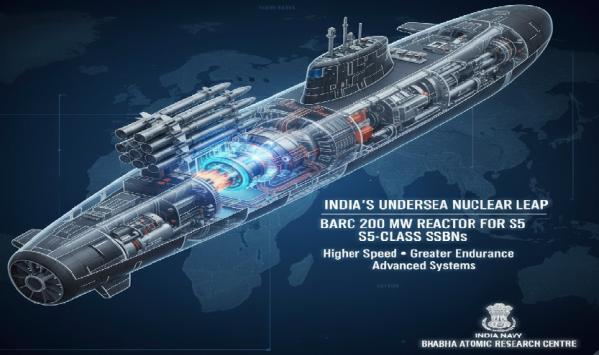
India’s nuclear deterrence program is quietly preparing for its next big leap. Reports suggest that the Bhabha Atomic Research Centre (BARC) is working on a powerful 200 MW pressurized water reactor (PWR) to propel the country’s upcoming S5-class nuclear ballistic missile submarines (SSBNs).
This development signals more than a technical upgrade — it represents a decisive step in India’s ambition to secure a robust, survivable second-strike capability and expand its influence in the Indo-Pacific maritime domain.
From 83 MW to 200 MW: The Journey of India’s Naval Reactors
India’s nuclear submarine story began with the INS Arihant, launched in 2009 and commissioned in 2016. Powered by an 83 MW reactor developed by BARC with Russian design assistance, Arihant proved that India could build and operate nuclear propulsion systems indigenously.
The second phase — the Arihant-class successors (Arighat and others) — moved toward more capable 90+ MW reactors, sufficient for extended patrols and carrying K-15 and K-4 nuclear missiles.
But the future S5-class is envisioned as a truly blue-water strategic asset, larger in size, carrying more long-range ballistic missiles, and requiring a reactor in the 190–200 MW bracket. This represents more than double the output of India’s first nuclear propulsion designs.
Why a 200 MW Reactor is a Game-Changer
A jump from 190 MW to 200 MW may look incremental on paper, but in naval propulsion, every megawatt counts.
-
Higher submerged speed & maneuverability – A more powerful reactor allows an SSBN to cruise faster underwater for longer durations, while remaining stealthy.
-
Greater endurance – Unlike diesel-electric submarines, nuclear boats rely on reactor power. With increased capacity, patrol cycles can extend for months, covering far oceans.
-
Powering advanced systems – Next-gen submarines will house powerful sonar suites, electronic countermeasures, missile launch systems, and life-support modules that consume huge electrical loads.
-
Stealth & survivability – A bigger reactor can be optimized for quieter operations, reducing acoustic signatures and making the submarine harder to detect.
For an SSBN — whose core mission is to remain hidden and ensure a guaranteed retaliatory strike — these factors define credibility.
What Makes the S5-Class Different?
Unlike the Arihant-class, which can carry 4–8 ballistic missiles, the S5-class will reportedly be larger, heavier (up to 13,000 tons), and capable of carrying 12–16 long-range SLBMs (Submarine-Launched Ballistic Missiles).
The 200 MW reactor is central to enabling this expansion:
-
More missile tubes require a bigger hull.
-
A bigger hull needs more power to maneuver efficiently.
-
Extra onboard systems require stronger electrical generation.
Simply put: without a reactor upgrade, the S5 vision cannot materialize.
Challenges BARC Must Overcome
Designing a compact, high-power reactor for submarines is a different ballgame compared to land-based reactors. BARC engineers face multiple hurdles:
-
Thermal efficiency & cooling – Submarine reactors produce enormous heat that must be silently dissipated to avoid detection.
-
Miniaturization – Power must rise without drastically increasing reactor size or weight.
-
Safety under pressure – A submarine operates under immense underwater pressure; reactor shielding and containment must hold even in emergencies.
-
Long refueling cycles – Naval reactors are expected to run for over a decade without refueling. Designing such fuel cores requires advanced metallurgy and enrichment expertise.
-
Integration with submarine design – Hull, ballast systems, and reactor must be engineered in tandem, which means close cooperation between BARC, the Indian Navy, and shipyards like Visakhapatnam’s Shipbuilding Centre (SBC).
Geopolitical Implications
A fleet of S5-class SSBNs armed with a 200 MW reactor will have far-reaching consequences:
-
Strengthening nuclear deterrence – India’s no-first-use policy depends on credible second-strike forces. A powerful SSBN fleet guarantees survivability.
-
Balancing China – With China deploying Type 094 Jin-class and developing Type 096 SSBNs, India needs parity in undersea nuclear deterrence.
-
Maritime dominance in the Indo-Pacific – India’s submarine patrols could extend farther into contested waters, projecting presence.
-
Arms race dynamics – Pakistan, with Chinese help, may accelerate its pursuit of nuclear submarines or advanced anti-submarine warfare (ASW) tech.
Beyond Military: Tech Spillovers
BARC’s innovations won’t stop at submarines. A 200 MW compact reactor involves breakthroughs in high-density fuel, metallurgy, control systems, and thermal hydraulics. These can enhance:
-
Civil nuclear energy efficiency.
-
Space exploration (mini nuclear propulsion systems).
-
Medical isotope production.
-
Advanced material sciences.
In other words, military R&D will spill over into India’s scientific and industrial ecosystem.
Looking Ahead
The reactor is reportedly in advanced stages of development, but timelines for deployment remain speculative. Defence watchers believe:
-
Early S5 submarines (late 2030s) may use the 190 MW version.
-
Later units (2040 onwards) could field the upgraded 200 MW reactor.
-
By the mid-21st century, India’s SSBN fleet may transition fully to reactors in this power range.
Final Thoughts
India’s submarine reactor program is a story of quiet persistence. From a humble 83 MW start, BARC now appears ready to field a 200 MW powerhouse, propelling the S5-class into the realm of true strategic deterrence.
For a nation seeking to safeguard its security in an increasingly volatile Indo-Pacific, this is not just an engineering triumph — it’s a statement of intent.
The seas may remain silent, but India’s message is loud and clear: its nuclear deterrent is evolving, and its undersea guardians are only getting stronger.
Related Articles
-
Not Only Subhash Chandra Bose: Jaipal Singh Munda Also Left ICS to Lead India at the 1928 Olympics
Discover how Jaipal Singh Munda & Subhash Chandra Bose left ICS to serve India—Jaipal led India to its first Olympic hockey gold in 1928, a story of courage, leadership & patriotism...
 created by PolyEyes Staff | publish 11 hrs ago | last updated 11 hrs ago 795 views | 1 recommendations | 0 comments
 -
108 Lives Lost Every Year: How Jharkhand Became India’s Deadliest Human–Elephant Conflict Zone
Jharkhand records an alarming average of 108 human and elephant deaths every year, making it India’s deadliest human–elephant conflict hotspot....
created by PolyEyes Staff | publish 11 hrs ago | last updated 11 hrs ago 958 views | 1 recommendations | 0 comments -
🗳️ 66.94% — Record High Voter Turnout Since Independence: What It Really Means for India’s Democracy
India witnessed a historic 66.94% voter turnout — the highest since Independence. Is this a win for democracy, or a sign of deeper political awakening? Explore the data, meaning, and hidden messages behind this record participation....
created by PolyEyes Staff | publish 11 hrs ago | last updated 11 hrs ago 937 views | 1 recommendations | 0 comments -
🌨️ La Niña 2025 Alert: Is India Headed for Its Coldest Winter in Decades? Experts Warn of a Freezing Shock!
India braces for a harsh La Niña winter in 2025. Experts warn of extreme cold waves, heavy snowfall, and economic shocks. Learn why this winter could be historic....
created by PolyEyes Staff | publish 11 hrs ago | last updated 11 hrs ago 2007 views | 1 recommendations | 0 comments -
CP Radhakrishnan Becomes India’s 15th Vice President: Full Results, Reactions & What Comes Next
CP Radhakrishnan elected as India’s 15th Vice President 2025 with 452 votes. Get full results, analysis, reactions, and political impact here....
created by PolyEyes Staff | publish 11 hrs ago | last updated 11 hrs ago 1084 views | 1 recommendations | 0 comments -
🛤️ Patna Delhi Train Travel Now Slashes to 9 Hours: New Sleeper Vande Bharat Set to Launch!
Indian Railways to launch Sleeper Vande Bharat between Patna and Delhi, slashing travel time to just 9 hours. Full route, timing, fare, booking info & more....
created by PolyEyes Staff | publish 11 hrs ago | last updated 11 hrs ago 1050 views | 1 recommendations | 0 comments -
🖋️ Prem Behari Narain Raizada: The Man Who Handwrote the Indian Constitution in Italic Gold
Discover the untold story of Prem Behari Narain Raizada—the legendary calligrapher who handwrote the Indian Constitution in a flowing italic style, blending tradition, beauty, and national pride....
created by PolyEyes Staff | publish 11 hrs ago | last updated 11 hrs ago 1672 views | 1 recommendations | 0 comments -
🇮🇳 It Took ₹64 Lakh to Frame the Indian Constitution — The Law That Now Governs 140+ Crore Indians!
The Indian Constitution — the backbone of the world's largest democracy — was created at a cost of just ₹64 lakh. Framed with unmatched vision and patriotism, this document now governs over 140 crore Indians. Here's the epic journey of India's most powerful legal framework....
created by PolyEyes Staff | publish 11 hrs ago | last updated 11 hrs ago 1944 views | 1 recommendations | 0 comments -
📱 Bihar Becomes First Indian State to Launch Mobile Voting App: A New Era of Digital Democracy Begins!
Bihar has made history by becoming the first state in India to enable citizens to vote through a secure mobile app. This landmark move marks the beginning of a new digital democracy era—where voting can happen with just a tap....
created by PolyEyes Staff | publish 11 hrs ago | last updated 11 hrs ago 1248 views | 1 recommendations | 0 comments -
🚢 Patna Water Metro: In-Depth Look at Challenges and Benefits of Bihar’s Boldest River Transport Plan
Explore the in-depth details of Patna Water Metro, Bihar’s ambitious river transport system. Discover its benefits, major challenges, costs, timeline, and how it can reshape urban mobility in India....
created by PolyEyes Staff | publish 11 hrs ago | last updated 11 hrs ago 1313 views | 0 recommendations | 0 comments





-
Kakori Brand for GI-Tagged Malihabadi Dashehari Mango: How Uttar Pradesh Is Blending Heritage, History and Global Branding
July ,08 2026 - PolyEyes Staff -
JPSC PT Result Without Cut-Off, Final Answer Key Disputes & Just 16 Days for Mains: Why Aspirants Are Calling the 14th Recruitment Process Unfair
July ,06 2026 - PolyEyes Staff -
JPSC 14th Prelims Result Sparks Massive Controversy: No Cut-Off, No Member Signatures, Multiple Correct Answers – Is a Fresh Recruitment the Only Fair Solution?
July ,04 2026 - PolyEyes Staff -
Supreme Court Declares Right to Walk a Fundamental Right: A Landmark Victory for Every Indian
June ,22 2026 - PolyEyes Staff -
JPSC 14th Exam Faces Double Age-Cutoff Crisis: 2018 and 2022 — Why a Fresh Notification May Be the Only Fair Solution
June ,20 2026 - PolyEyes Staff -
Strait of Hormuz: How the Hormuz Crisis Could Trigger a Global Oil Shock and Impact India's Economy
May ,30 2026 - PolyEyes Staff -
🚀 Unemployment in India: Crisis, Causes & the Road to Jobs
April ,16 2026 - PolyEyes Staff -
🦋 Kya Aapko Pata Hai? Titli Ko Udne Ke Liye Do Baar Janm Lena Padta Hai
April ,13 2026 - PolyEyes Staff -
🌊 BIOROCK, Coral Reefs & Rann of Kutch: The Future of Ocean Restoration & Climate Survival
April ,12 2026 - PolyEyes Staff -
🌍 Oil War 2026: USA, Iran, Israel, Venezuela aur Petroleum ka Global Game (Aapki Pocket Ka Silent Killer 😅)
April ,06 2026 - PolyEyes Staff -
🛕🔥 Devari Mandir, Dhoni & CSK: IPL 2026 ka Divine Connection
April ,06 2026 - PolyEyes Staff -
Jharkhand Economy: Complete Notes for JPSC 2026 (Growth, Sectors, Challenges & Opportunities)
April ,05 2026 - PolyEyes Staff -
🤖 Best AI SEO Tools for Bloggers in 2026 (Rank Faster & Grow Traffic)
April ,05 2026 - PolyEyes Staff -
Jharkhand Industrial Policy (2001–2021): Complete Evolution, Analysis & JPSC PT Master Guide (2026)
April ,04 2026 - PolyEyes Staff -
🎓 Best AI Tools for Students in 2026 (Study Smarter, Not Harder)
April ,04 2026 - PolyEyes Staff

Sir I've lost my admit card and I also forget my roll no
Please help me in other ways

Dear Sir,
After login when i click on attempt button to take test a error msg show "Test series ended", plesae resolve this issue.
sir, my name is SWARUP ANAND, my DOB- 01/03/1984, my father’s name- SANTOSH KUMAR SRIVASTWA. I have loss my admit card. Please tell my roll number.
BPSC mains 56th-59th me Roll No. 119040 pass hai aur PT me fail. Mahabhrstachar hai. pls see it must
I am thankful for PolyEyes for most authentic Online BPSC Test Series. These Test are life support for working Aspirant.
sir please tell the authenticity of this news .there is no such news on bpsc website and i heard 17 june as the exam date .please clarify the doubt
r u providing test for BPSC in HINDI medium ?
plz intimate me through emails about BPSC test packages and details of packages and its rate. how many test and when it will be taken plz send details about ur package plans.
Yes Test is available in Hindi as well English and Total Number of Test and Registration details already given above
Best thing im loving about This Test series is its Explanation part. Crisp and to the Point. Thanku Polyeyes.
-
 All Stories
 -
Recently Published Stories
-
Most Viewed Stories
-
Just In Photos
-
Most Viewed Photos
