
By - PolyEyes Staff
views 35
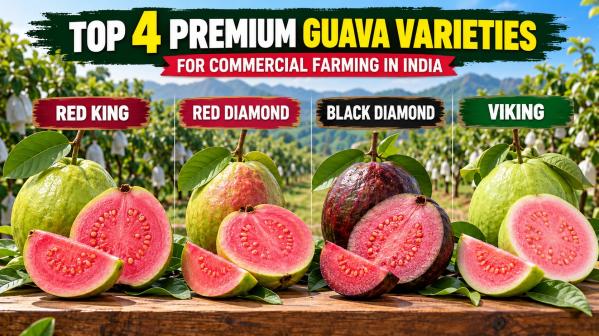
Discover the new generation of premium guava varieties attracting attention in India's fruit market. Learn about their commercial potential, climate suitability, orchard planning, investment risks, and how farmers can choose the right variety for profitable guava farming.
India's guava industry is entering an exciting phase. Consumers are becoming increasingly interested in attractive fruit colours, crisp textures, sweetness, premium presentation, and varieties that can stand out in competitive fruit markets.
Against this backdrop, Red King, Red Diamond, Black Diamond, and Viking are names worth investigating for farmers considering premium guava cultivation.
But one question matters more than the name of a variety: Which guava can deliver the best combination of fruit quality, reliable production, local market demand, and farm-level profitability?
This guide examines these four varieties from a commercial farming perspective while explaining what farmers should verify before investing in a new orchard.
Quick Answer: Are These the Top 4 Commercial Guava Varieties for Pan-India Cultivation?
Red King, Red Diamond, Black Diamond, and Viking can form an interesting shortlist for farmers exploring newer or premium-positioned guava cultivars. However, there is not enough independently verified, publicly available comparative trial data to establish them as India's definitive top four commercial guava varieties.
Their performance can vary according to climate, soil, irrigation, plant material, pruning, fruiting season, and local consumer preferences.
| Guava variety | Commercial consideration | What farmers should verify |
|---|---|---|
| Red King | A premium variety to evaluate for fresh-fruit markets | Heat performance, fruit quality, yield and buyer demand |
| Red Diamond | An emerging premium cultivar associated with attractive fruit characteristics | Local performance during hot weather and fruit acceptance |
| Black Diamond | A newer cultivar name worth investigating | Authentic cultivar identity, flesh colour, productivity and marketability |
| Viking | A variety name requiring careful identification before investment | Botanical identity, nursery provenance and regional trial results |
Important: These are evaluation categories, not a scientific ranking. Do not assume that every plant sold under these names has identical genetics or characteristics.
For farmers who need established reference points, Indian horticultural research has documented varieties such as Arka Kiran, CISH Lalit, and CISH Shweta. ICAR reports useful information on their fruit characteristics and performance, providing a basis for comparing newer commercial selections with established cultivars.
1. Red King Guava: A Premium Cultivar to Evaluate
Red King is attracting attention in discussions about newer premium guava selections. Its commercial value should be assessed through actual fruit quality, tree performance, and the prices buyers are willing to pay in the farmer's target market.
Why farmers may consider Red King
-
Premium market positioning: An opportunity to investigate demand for differentiated guava rather than relying exclusively on conventional fruit categories.
-
Potential for fresh-fruit sales: Suitable market channels would depend on the cultivar's verified eating quality, appearance, and handling characteristics.
-
Opportunity for orchard diversification: A small trial plantation can help farmers determine whether this selection performs better economically than their existing varieties.
Recent trade reporting has described Red King as a selection positioned to combine a rounded fruit shape with improved heat tolerance relative to certain other premium selections. These descriptions should be verified with the supplier and local trial results before they are used to predict farm performance.
Is Red King suitable for all Indian states?
Not automatically. Heat tolerance, humidity response, fruit set, disease pressure, and fruit quality must be assessed under local growing conditions.
Before planting commercially, ask the nursery for the cultivar's documented identity, fruit photographs from mature trees, fruiting records, and references from growers in a comparable climate.
Commercial verdict: Consider Red King for a controlled orchard trial where premium-fruit buyers are available. Avoid committing the entire farm until its productivity and selling price have been demonstrated locally.
2. Red Diamond Guava: Is There a Premium-Market Opportunity?
Red Diamond is another name appearing in India's developing premium-guava segment. Its appeal to a farmer depends not only on the appearance of the fruit but also on the consistency of production, eating quality, and ability to reach buyers in good condition.
Potential commercial advantages
-
A differentiated product may help attract fruit retailers and customers seeking alternatives to conventional guava.
-
Premium positioning may create opportunities for direct sales, selected fruit grading, and attractive retail packaging.
-
A successful cultivar can diversify a grower's product portfolio and reduce dependence on a single market category.
However, attractive fruit alone does not guarantee higher profits. Fruit size, sweetness, firmness, seed characteristics, yield per tree, and the percentage of marketable fruit all influence commercial results.
The heat-tolerance question
Heat is particularly important when selecting guava cultivars for India's plains.
Trade reporting on emerging guava varieties has highlighted challenges for Red Diamond under temperatures above approximately 35–36°C. It has also discussed Red Diamond 1 as a separate selection reported to have better heat tolerance.
Red Diamond and Red Diamond 1 should not be treated as interchangeable names. Farmers should verify exactly which cultivar is being offered and seek reliable evidence of its performance under local summer conditions.
Where should farmers test Red Diamond?
Farmers in hot, subtropical regions should conduct a small comparative trial before scaling up. Record fruit set, fruit drop, irrigation requirements, pest and disease incidence, marketable yield, and buyer feedback.
Commercial verdict: Red Diamond may deserve a place in a premium-guava trial, but its economic suitability should be established for the particular region and cultivar supplied.
3. Black Diamond Guava: An Opportunity Worth Investigating Carefully
Black Diamond is included in discussions of newer guava selections, but its exact characteristics need particular attention because similar-sounding commercial names do not always identify the same cultivar.
Before purchasing plants, farmers should establish whether the variety has a documented pedigree, verified fruit characteristics, and a track record under Indian conditions.
What makes Black Diamond commercially interesting?
A new or visually distinctive fruit cultivar may be attractive if it offers a clear benefit to consumers or wholesalers. However, the commercial case must be supported by evidence rather than the variety's name.
Farmers should investigate:
-
Fruit appearance: What is the verified skin colour and flesh colour at maturity?
-
Eating quality: Is the fruit sweet, crisp, aromatic, or otherwise preferred by local customers?
-
Yield: How much marketable fruit does a mature tree produce under comparable conditions?
-
Shelf life: How long can the harvested fruit remain saleable under normal handling and storage?
-
Market demand: Are local retailers, wholesalers, or direct customers willing to buy it repeatedly?
-
Plant authenticity: Can the supplier establish the identity and propagation history of the planting material?
Should farmers pay a premium for Black Diamond plants?
Only after comparing the additional plant cost with credible evidence of commercial benefits.
A nursery's claims about extraordinary fruit prices or unusually high yields are not substitutes for replicated trials, mature-tree records, and actual sales receipts.
Commercial verdict: Treat Black Diamond as an investigational option until reliable cultivar information and local performance data are available.
4. Viking Guava: Verify the Variety Before Scaling Up
Viking is the fourth name in this premium-guava shortlist. Before evaluating its commercial potential, farmers should confirm the exact cultivar identity, because a name used in nursery marketing may not be sufficient to establish genetic identity or regional suitability.
What should farmers evaluate?
A practical assessment should cover the following factors:
-
Tree vigour and canopy structure.
-
Time to first harvest and the development of commercial yields.
-
Average fruit weight and the percentage of fruits meeting market standards.
-
Taste, sweetness, texture, seed characteristics, and consumer acceptance.
-
Response to high temperatures, humidity, and local rainfall.
-
Susceptibility to locally important pests and diseases.
-
Harvesting, transport, storage, and handling performance.
These characteristics should be established from documented cultivar information or a properly managed field trial rather than assumed from the variety name.
Can Viking become a profitable commercial variety?
Potentially, if verified plant material produces consistent, marketable fruit and the realised selling price covers production and distribution costs.
The relevant question is not simply whether Viking can grow in a particular state. It is whether the variety can produce a dependable commercial crop at an acceptable cost under that state's specific growing conditions.
Commercial verdict: Confirm the identity and obtain local evidence before making a substantial investment in Viking guava.
Established Guava Varieties Farmers Should Compare Against
New cultivars should be assessed against proven alternatives. Indian horticultural research provides several useful benchmarks.
Arka Kiran
ICAR describes Arka Kiran as a pink- to dark-red-fleshed guava with an average fruit weight of around 200–220 g, total soluble solids (TSS) of 11–12°Brix, and reported lycopene content of 7.14 mg per 100 g. ICAR also reports an average yield of 20 tonnes per acre at a spacing of 4 m × 3 m in its variety information.
These are reported performance figures, not guaranteed results for every farm. Regional conditions and cultivation practices influence actual yields.
CISH Lalit
ICAR reports an average fruit weight of approximately 185–200 g and yield of around 100 kg per plant for CISH Lalit. Its pink pulp makes it relevant to both fresh consumption and processing.
CISH Shweta
ICAR reports fruit weight of around 250 g, TSS of 12.5–13.2°Brix, and yields of 85–90 kg per plant.
These figures provide reference points for farmers evaluating new premium cultivars. They should not be compared directly unless tree age, planting density, climate, management, and the method of measuring yield are comparable.
Which Guava Variety Is Best for Different Indian Regions?
India has diverse fruit-growing conditions, so a variety that performs well in one region may not deliver the same results elsewhere.
| Region | Key growing considerations | Recommended approach |
|---|---|---|
| Bihar and eastern Uttar Pradesh | Hot summers, monsoon humidity, and possible waterlogging | Test summer performance, drainage, fruit quality, and disease response |
| Punjab, Haryana, and western Uttar Pradesh | Hot summers, winter temperature variation, and irrigation availability | Compare heat response, winter crop performance, and marketable yield |
| Maharashtra and Gujarat | Local variation in rainfall, heat, and irrigation access | Assess water requirements, fruit quality, and seasonal market demand |
| Karnataka, Andhra Pradesh, and Telangana | Differences in rainfall, temperature, and production systems | Evaluate local fruiting patterns and buyer preferences |
| Tamil Nadu and other southern regions | Regional differences in heat, rainfall, and humidity | Conduct trials suited to the specific district and production season |
| Northeast India and humid eastern regions | Rainfall, humidity, drainage, and disease pressure | Prioritise locally adapted material and strong orchard sanitation |
This is a regional evaluation framework, not a claim that all four named cultivars have been validated in every state. Farmers should consult their nearest Krishi Vigyan Kendra (KVK), state horticulture department, or agricultural university for local recommendations.
Commercial Guava Farming: How to Select the Right Variety
Choosing the right cultivar is one of the most important orchard decisions because a guava plantation is a long-term investment.
Step 1: Identify your target customer
Different buyers have different requirements.
-
Local fruit markets: Consistent quality, attractive appearance, acceptable taste, and competitive pricing.
-
Premium retail stores: Uniform grading, appearance, firmness, packaging, and reliable supply.
-
Fruit wholesalers: Marketable volume, handling durability, and predictable harvest schedules.
-
Processing businesses: Pulp recovery, flavour, colour, pectin characteristics, and processing suitability.
-
Direct-to-consumer sales: Repeat purchases, eating quality, presentation, and customer trust.
Do not assume that a variety suited to premium retail will automatically be the most profitable for wholesale or processing.
Step 2: Buy genuine planting material
Purchase plants from a traceable nursery that can identify the cultivar and provide appropriate documentation.
Before ordering, confirm:
-
The exact variety and any suffix or selection number.
-
The propagation method and source of mother plants.
-
Whether the supplier has mature-tree fruiting records.
-
Whether the variety has been evaluated in your climate.
-
The nursery's replacement policy for mislabelled or unhealthy plants.
A correctly identified plant is essential for evaluating any new cultivar.
Step 3: Start with a trial plantation
Instead of planting an entire farm with an unfamiliar variety, establish a small trial block and compare it with a proven local cultivar.
Keep records of:
-
Plant survival and growth.
-
Flowering and fruit set.
-
Fruit drop and harvest timing.
-
Fruit weight and quality.
-
Total yield and marketable yield.
-
Labour, irrigation, fertiliser, and plant-protection costs.
-
Actual selling prices and buyer feedback.
Evaluate performance over more than one harvest season before deciding whether to expand.
Soil, Climate and Planting Requirements for Commercial Guava
Guava is adaptable to a range of tropical and subtropical environments, but commercial production still depends on appropriate site selection and orchard management.
Soil
Deep, well-drained soil is generally preferable. Sandy loam to suitable clay-loam soils can support productive orchards when drainage and fertility are properly managed.
A soil test can help determine pH, nutrient availability, and amendments needed before planting. Avoid poorly drained sites where water accumulates around the root zone.
Climate
Guava can be cultivated in tropical and subtropical regions, but flowering, fruit set, fruit quality, and harvest timing respond to local weather.
For newer premium cultivars, pay particular attention to extreme summer temperatures and humid periods. Claims of heat tolerance should be supported by field observations or reliable trial results.
Spacing
Planting distance should be selected according to cultivar vigour, canopy management, machinery access, irrigation arrangements, and whether the orchard will use a conventional or high-density system.
Conventional orchards and high-density orchards have different management requirements. High-density planting can increase the number of trees per hectare, but it also demands disciplined pruning, canopy control, and irrigation and nutrient management.
Do not copy a high-density layout simply because a nursery advertises a high number of plants per acre.
Irrigation
Young guava plants require reliable moisture for establishment, especially during hot weather. Mature-tree irrigation should be adjusted according to soil type, rainfall, plant age, crop load, and local evaporative demand.
Drip irrigation can improve water management when correctly designed. Excessive irrigation and poor drainage, however, can damage roots and compromise tree health.
Pruning and canopy management
Guava fruits develop on new growth, making suitable pruning and canopy management important. The exact timing and intensity should match the production system, cultivar, and intended harvest season.
Seek local technical guidance before adopting intensive pruning schedules for a new variety.
Guava Farming Profit: How to Calculate Realistic Returns
Premium guava can offer an attractive business opportunity, but higher selling prices do not automatically mean higher farm profits.
A profitable orchard must combine marketable production, controlled costs, reliable buyers, and manageable post-harvest losses.
Example: Calculating orchard revenue
Consider a hypothetical orchard producing 10,000 kg of marketable guava in a season.
| Average realised selling price | Gross seasonal revenue |
|---|---|
| ₹20/kg | ₹2,00,000 |
| ₹30/kg | ₹3,00,000 |
| ₹40/kg | ₹4,00,000 |
| ₹50/kg | ₹5,00,000 |
These are illustrative calculations, not current market quotations or yield predictions for Red King, Red Diamond, Black Diamond, or Viking.
Actual revenue depends on the amount of saleable fruit, grading, rejected fruit, commission, transport, season, and the price received by the farmer.
Calculate net operating profit
Use this formula:
Net operating profit = Gross sales − Total operating expenses
Operating expenses may include:
-
Labour and harvesting.
-
Fertilisers and soil amendments.
-
Irrigation and electricity.
-
Pest and disease management.
-
Pruning and orchard maintenance.
-
Packaging, grading, and transport.
-
Market commission and wastage.
For a complete investment analysis, also account for establishment costs, the time required for trees to reach commercial production, financing costs, land costs where applicable, and replacement of failed plants.
Why premium pricing can be misleading
A new variety may receive a high price when supply is limited. As more farmers plant it, the market price can change.
Similarly, a visually attractive fruit may earn a premium only if customers appreciate its taste, consistency, and quality. The farm's profitability must be based on realistic selling prices rather than the highest price seen in a promotional video or nursery advertisement.
Major Risks in Planting New Guava Varieties
1. Mislabelled plants
Different cultivars may be sold under similar commercial names. This can lead to disappointing results even when the farmer follows recommended cultivation practices.
2. Unverified yield claims
Yield estimates are meaningful only when the tree age, planting density, location, and production conditions are known.
3. Climate mismatch
A cultivar may grow vegetatively yet perform poorly in flowering, fruit set, or fruit quality under local weather conditions.
4. Uncertain market demand
A premium variety may not command a premium price in every wholesale market. Obtain feedback from potential buyers before expanding.
5. Post-harvest losses
Soft fruit, poor grading, unsuitable packaging, and long transport distances can reduce the amount of fruit that reaches consumers in saleable condition.
6. Overinvestment in a single cultivar
Planting an entire orchard with an untested selection increases exposure to production and market risks. A diversified, evidence-based approach can be more prudent.
Frequently Asked Questions (FAQs)
Which are the top four commercial guava varieties for India in 2026?
Red King, Red Diamond, Black Diamond, and Viking are four names that farmers may wish to investigate when considering newer premium guava cultivars. However, there is no verified national comparative trial establishing them as India's definitive top four varieties. Local performance and market demand should determine the final selection.
Is Red Diamond guava suitable for hot Indian summers?
Its suitability depends on the exact cultivar and local conditions. Trade reporting has identified heat-related challenges for Red Diamond in very hot weather and distinguishes it from Red Diamond 1. Farmers should verify cultivar identity and obtain local field evidence before investing.
What is the difference between Red Diamond and Red Diamond 1?
They should be treated as separate selections unless reliable cultivar documentation establishes otherwise. Do not assume that their fruit characteristics or heat tolerance are identical.
Is Black Diamond guava profitable?
Profitability depends on authentic planting material, marketable yield, production expenses, fruit quality, and the actual price received. Reliable local yield and sales records are needed to estimate its commercial potential.
Is Viking guava suitable for pan-India cultivation?
Pan-India suitability cannot be assumed from the variety name alone. Farmers should confirm the exact cultivar identity and evaluate its performance under their local climate and management conditions.
Which guava variety is best for commercial farming in Bihar?
The best choice depends on the district, soil drainage, irrigation, intended harvest season, buyer preferences, and availability of authentic plants. Compare newer cultivars with established options such as Red King, Viking CISH Lalit, CISH Shweta, and suitable locally recommended varieties.
How many guava plants can be planted in one acre?
The number depends on the spacing and orchard system. For example, at 6 m × 6 m spacing, one acre accommodates approximately 112 planting positions before allowing for paths, boundaries, and other unusable space. Closer spacing accommodates more plants but requires a different management system.
When should a farmer expect commercial returns from a new guava orchard?
The timeline varies with cultivar, planting material, climate, and management. Early fruiting does not necessarily mean the orchard has reached stable commercial production. Prepare a multiyear budget rather than relying on promises of immediate high returns.
Can farmers sell premium guava directly to customers?
Yes, where a suitable customer base and distribution arrangement exist. Direct sales can reduce dependence on wholesale channels but require customer acquisition, grading, packaging, delivery, and consistent quality.
Final Verdict: Choose Guava Varieties by Evidence, Not Hype
Red King, Red Diamond, Black Diamond, and Viking offer an interesting starting point for exploring newer guava cultivars. Their commercial value, however, must be demonstrated through authentic plants, regional field performance, and real buyer demand.
For Indian farmers, the strongest strategy is to compare promising new selections with established varieties, conduct small trials, document yields and costs, and expand only when the numbers support the investment.
The winning guava variety is not necessarily the one with the most attractive name. It is the one that consistently produces saleable fruit, satisfies customers, and delivers sustainable profits under your farm's conditions.
Before planting, consult your local horticulture department, agricultural university, or KVK, and verify cultivar identity with a traceable nursery.
Related Articles
-
Supreme Court Declares Right to Walk a Fundamental Right: A Landmark Victory for Every Indian
The Supreme Court has declared the Right to Walk a Fundamental Right under Article 21 of the Constitution. The landmark ruling strengthens pedestrian rights, promotes safer roads, and pushes governments to prioritize walkable and inclusive urban infrastructure across India....
 created by PolyEyes Staff | publish 11 hrs ago | last updated 11 hrs ago 502 views | 1 recommendations | 0 comments
-
🌊 BIOROCK, Coral Reefs & Rann of Kutch: The Future of Ocean Restoration & Climate Survival
Discover how Biorock technology is transforming coral reefs in the Rann of Kutch. A powerful climate solution for ocean restoration, biodiversity, and coastal protection....
created by PolyEyes Staff | publish 11 hrs ago | last updated 11 hrs ago 910 views | 1 recommendations | 0 comments -
PM JANMAN Yojana 2026: India’s Most Powerful Tribal Development Mission Explained
PM JANMAN Yojana 2026 complete guide. Learn about benefits, budget ₹24,000 crore, PVTG development plan, states covered, and exam-ready notes for UPSC & JPSC....
created by PolyEyes Staff | publish 11 hrs ago | last updated 11 hrs ago 1061 views | 1 recommendations | 0 comments -
🚀 Top AI Tools to Make Money Online in 2026 (India Edition – Real Income Blueprint)
2026 me AI tools se paise kaise kamayein? Blogging, AdSense, digital products, automation aur Shopify ke through real income generate karne ka complete India-focused blueprint....
created by PolyEyes Staff | publish 11 hrs ago | last updated 11 hrs ago 770 views | 1 recommendations | 0 comments -
🔥 Jhdugoda Tailing Pond Radiation: India’s Silent Nuclear Hazard Explained in Hinglish
Discover the hidden dangers of Jhdugoda tailing ponds in Jharkhand. Learn about nuclear radiation, health risks, environmental impact, and safety measures in uranium mining zones. Stay informed on radioactive contamination and its effects on local communities. ...
created by PolyEyes Staff | publish 11 hrs ago | last updated 11 hrs ago 745 views | 1 recommendations | 0 comments -
Zoho CRM Implementation - DIY vs Hiring a Zoho Partner
Zoho CRM is a powerful platform designed to help businesses manage leads, automate sales processes, and improve customer relationships....
created by Mr. Senthil Nath | publish 11 hrs ago | last updated 11 hrs ago 443 views | 0 recommendations | 0 comments -
Gogabil Jheel Declared Ramsar Site: Bihar Enters India’s Top 3 Wetland States as India Rises to Global Rank 3
Gogabil Jheel in Katihar, Bihar gets Ramsar Site status. India becomes Asia’s No.1 and World’s No.3 in wetlands with 94 Ramsar Sites. Full details inside....
created by PolyEyes Staff | publish 11 hrs ago | last updated 11 hrs ago 1292 views | 1 recommendations | 0 comments -
🌍 The Mysterious Twist of Earth: How the Coriolis Force Secretly Controls Our World!
Discover how the mysterious Coriolis force silently controls hurricanes, ocean currents, and flight paths — an invisible twist that keeps Earth’s systems in perfect motion....
created by PolyEyes Staff | publish 11 hrs ago | last updated 11 hrs ago 1277 views | 1 recommendations | 0 comments -
🔥 After 20 Long Years, India’s Only Mud Volcano Erupts Again in Andaman-Nicobar — Nature’s Hidden Power Unleashed!
India’s only Mud Volcano has erupted again after 20 years in the Andaman-Nicobar Islands. Discover what happened on October 2, 2025, why it’s a rare geological event, and how scientists are decoding this mysterious phenomenon....
created by PolyEyes Staff | publish 11 hrs ago | last updated 11 hrs ago 1243 views | 1 recommendations | 0 comments -
💥 “OctaFX ₹800 Crore Scam: How India Got Trapped in a Digital Money Maze!”
In a shocking turn of events, the Enforcement Directorate (ED) uncovered an ₹800 crore web of deceit, masterminded through OctaFX — an online forex platform promising easy wealth but allegedly running one of India’s biggest digital money-laundering rackets. Here’s the full inside story — how it bega...
created by PolyEyes Staff | publish 11 hrs ago | last updated 11 hrs ago 1159 views | 1 recommendations | 0 comments










-
Red King, Red Diamond, Black Diamond & Viking Guava: Top 4 Premium Commercial Guava Varieties for Indian Farmers in 2026
October ,29 2026 - PolyEyes Staff -
Why Melbourne Startups Choose a Dedicated UI UX Design Agency?
October ,23 2026 - Mr. Senthil Nath -
5 Questions to Ask Any Zoho Partner in Melbourne Before Signing a Contract
October ,21 2026 - Mr. Senthil Nath -
Why Most CRM Implementations Fail (And How a Zoho Partner Prevents It)
October ,20 2026 - Mr. Senthil Nath -
Zoho CRM Implementation Timeline - What Australian Businesses Should Expect
October ,19 2026 - Mr. Senthil Nath -
Kakori Brand for GI-Tagged Malihabadi Dashehari Mango: How Uttar Pradesh Is Blending Heritage, History and Global Branding
July ,08 2026 - PolyEyes Staff -
JPSC PT Result Without Cut-Off, Final Answer Key Disputes & Just 16 Days for Mains: Why Aspirants Are Calling the 14th Recruitment Process Unfair
July ,06 2026 - PolyEyes Staff -
JPSC 14th Prelims Result Sparks Massive Controversy: No Cut-Off, No Member Signatures, Multiple Correct Answers – Is a Fresh Recruitment the Only Fair Solution?
July ,04 2026 - PolyEyes Staff -
Supreme Court Declares Right to Walk a Fundamental Right: A Landmark Victory for Every Indian
June ,22 2026 - PolyEyes Staff -
JPSC 14th Exam Faces Double Age-Cutoff Crisis: 2018 and 2022 — Why a Fresh Notification May Be the Only Fair Solution
June ,20 2026 - PolyEyes Staff -
Strait of Hormuz: How the Hormuz Crisis Could Trigger a Global Oil Shock and Impact India's Economy
May ,30 2026 - PolyEyes Staff -
🚀 Unemployment in India: Crisis, Causes & the Road to Jobs
April ,16 2026 - PolyEyes Staff -
🦋 Kya Aapko Pata Hai? Titli Ko Udne Ke Liye Do Baar Janm Lena Padta Hai
April ,13 2026 - PolyEyes Staff -
🌊 BIOROCK, Coral Reefs & Rann of Kutch: The Future of Ocean Restoration & Climate Survival
April ,12 2026 - PolyEyes Staff -
🌍 Oil War 2026: USA, Iran, Israel, Venezuela aur Petroleum ka Global Game (Aapki Pocket Ka Silent Killer 😅)
April ,06 2026 - PolyEyes Staff

Sir I've lost my admit card and I also forget my roll no
Please help me in other ways

Dear Sir,
After login when i click on attempt button to take test a error msg show "Test series ended", plesae resolve this issue.
sir, my name is SWARUP ANAND, my DOB- 01/03/1984, my father’s name- SANTOSH KUMAR SRIVASTWA. I have loss my admit card. Please tell my roll number.
BPSC mains 56th-59th me Roll No. 119040 pass hai aur PT me fail. Mahabhrstachar hai. pls see it must
I am thankful for PolyEyes for most authentic Online BPSC Test Series. These Test are life support for working Aspirant.
sir please tell the authenticity of this news .there is no such news on bpsc website and i heard 17 june as the exam date .please clarify the doubt
r u providing test for BPSC in HINDI medium ?
plz intimate me through emails about BPSC test packages and details of packages and its rate. how many test and when it will be taken plz send details about ur package plans.
Yes Test is available in Hindi as well English and Total Number of Test and Registration details already given above
Best thing im loving about This Test series is its Explanation part. Crisp and to the Point. Thanku Polyeyes.
-
 All Stories
-
Recently Published Stories
-
Most Viewed Stories
-
Just In Photos
-
Most Viewed Photos
